

BLOG
How Modacrylic and Antistatic Fibers Work Together in FR Fabrics
[ 04.11.2026]
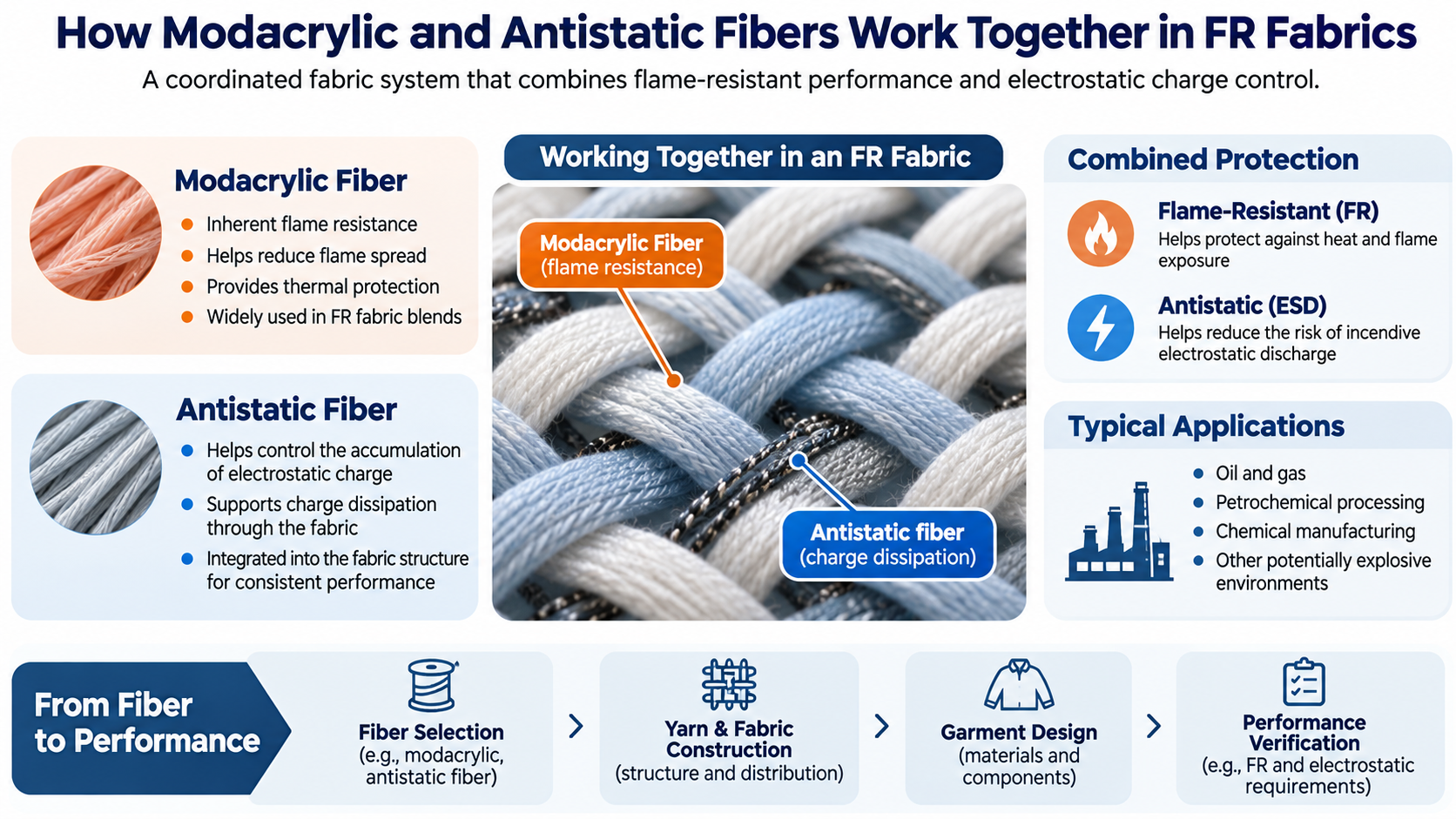
How Modacrylic and Antistatic Fibers Work Together in FR Fabrics
In flame-resistant workwear, protection against heat and flame is often only one part of the performance requirement. In industries where flammable gases, vapors or combustible materials may be present, controlling electrostatic charge can also be an important consideration.
This is where modacrylic and antistatic fibers can work together as part of an engineered FR fabric system.
The Role of Modacrylic in FR Fabrics
Modacrylic is widely used in flame-resistant textile blends because it provides inherent flame-resistant properties. Unlike a surface-applied treatment, the flame-resistant characteristics are built into the fiber itself.
In FR workwear, modacrylic is often blended with other fibers to achieve a balance between protective performance and practical wearability. Depending on the application, additional fibers may contribute to comfort, moisture management, durability or other functional properties.
However, flame resistance alone does not necessarily mean that a fabric provides the electrostatic performance required for antistatic protective clothing.
The Role of Antistatic Fibers
Antistatic fibers are incorporated into a fabric to help control the accumulation and dissipation of electrostatic charge.
When integrated into the fabric structure, these fibers can create pathways that support charge dissipation. Their effectiveness depends not only on the fiber itself, but also on factors such as fiber distribution, yarn and fabric construction, garment design and the conditions in which the garment is used.
For protective clothing designed to meet EN 1149-5 requirements, electrostatic performance is evaluated within a broader system of material and garment design requirements. The garment is also intended to be used as part of a properly earthed system; the clothing alone does not provide a complete solution to electrostatic hazards.
How the Two Fiber Systems Work Together
The two components address different protective functions:
| Fiber System | Primary Function |
|---|---|
| Modacrylic | Provides inherent flame-resistant properties |
| Antistatic Fiber | Helps control electrostatic charge and support charge dissipation |
When properly engineered into the same fabric, the result can be a material designed to address both thermal and electrostatic hazards.
The key point is that these functions should not be confused. Modacrylic contributes to the flame-resistant performance of the fabric, while antistatic fibers are incorporated to address electrostatic behavior. Neither function should automatically be assumed based solely on the presence of the other.
Fabric Construction Makes a Difference
Fiber composition is only the starting point. The way fibers are converted into yarn and fabric can significantly influence the final product.
Important development considerations include:
-
The selection and proportion of FR fibers
-
The type and distribution of antistatic components
-
Yarn construction and fabric structure
-
Fabric weight and intended garment application
-
Comfort, breathability and moisture management
-
Durability through the expected service and care cycle
-
Final fabric and garment testing
For example, antistatic components must be effectively integrated throughout the fabric structure to support consistent electrostatic performance. At the same time, the overall fabric must meet the flame-resistant and physical performance requirements of the intended application.
From Fiber Selection to Finished PPE
Developing FR antistatic fabrics is therefore a process of balancing multiple requirements rather than optimizing a single property.
For PPE manufacturers and brands, the development process should begin with the intended workplace hazards and product specification. The fiber blend and fabric construction can then be engineered around the required protective performance, comfort and durability.
This approach is particularly important for products intended for global markets, where a garment may need to address multiple hazards and comply with different technical requirements.
The most effective FR fabric is not defined by one fiber alone. It is the combination of material selection, fabric engineering, garment design and performance verification that determines whether the final product is suitable for its intended protective application.
Explore Our Technical Knitwear Solutions:
FR Base Layer | Seamless Knitwear | Merino Base Layers | Cooling Performance Wear | OEM & ODM Manufacturing